Spec · 2026
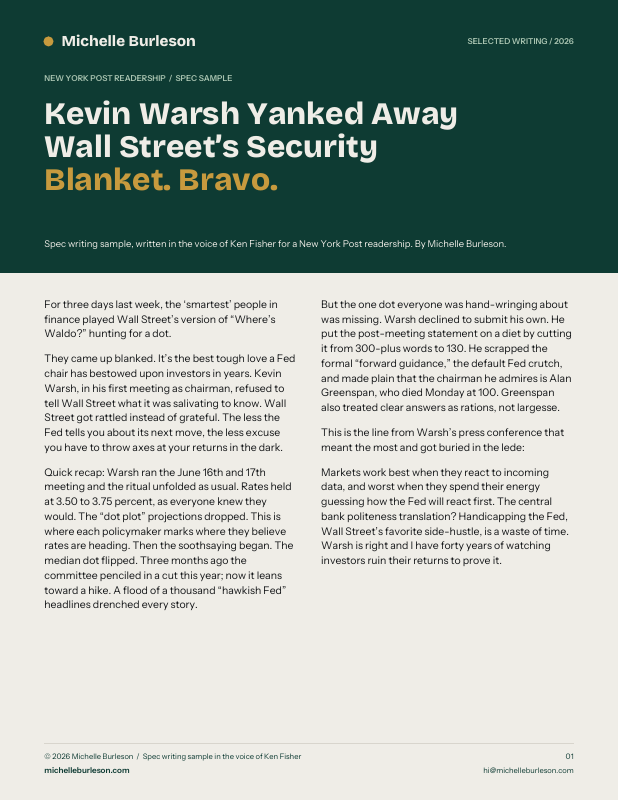
Kevin Warsh Yanked Away Wall Street's Security Blanket. Bravo.
Read the sample ↗A voice-match demonstration. Written as a named financial columnist would write it, for a New York Post readership, on the new Fed chair's first meeting.
I build AI-assisted publishing workflows, test what they produce, and bring senior editorial judgment to the work that carries your name.
For Deep Kimchi, I built an AI-assisted workflow with BlueRock to support the research and production behind my articles and podcast.
Each role has a defined assignment and review criteria.
I choose the angle, write and record the work, and decide what is ready to publish. I developed the story and directed the AI-assisted production of this video and companion guide to show how the workflow works in practice.
I can build this kind of content workflow for your team, around your subject matter and the people doing the work. That means deciding where AI is useful, where an experienced editor needs to step in, and what must be checked before anything reaches your audience.
AI content needs an experienced editor at the controls. I bring the writing judgment, production experience, and product testing to take it from an experiment to a working operation.
I build the workflow around the work: research assignments, editorial handoffs, quality checks, and publishing decisions. At Deep Kimchi, I use BlueRock to support a one-person media operation, with defined roles for AI and clear points where I review and decide.
At BlueRock, I test real user experiences across onboarding, content, and product use. I document where the experience breaks down, turn findings into specific recommendations, and retest changes. That work also informs messaging and the BlueRock for Builders curriculum.
I trace claims back to their sources, check whether the evidence supports the argument, and decide what needs more work. My research and fact-checking workflows help organize the evidence; I remain responsible for the angle, the words, and the final publication decision.
I run Deep Kimchi from research through publication: articles, podcast scripts, recording, email, and distribution. I connect those steps through reusable production workflows, so the article and episode carry the same argument while each works in its own format.
I turn a distinctive voice into guidance a team can use: style rules, source standards, review criteria, and examples. I apply those standards to AI-assisted work as well as human drafts, drawing on editorial systems work for Fannie Mae, VMware, and my own publication.
Finance, healthcare, government, enterprise technology. I bring decades of writing and editing experience to executive bylines, market commentary, and technical content. The job is to make a difficult subject understandable without losing what makes it accurate.
Accuracy is the starting point. I also ask:
The decision to publish stays with me.
A selection of client projects and writing samples beyond my confidential ghostwriting work.
A voice-match demonstration. Written as a named financial columnist would write it, for a New York Post readership, on the new Fed chair's first meeting.
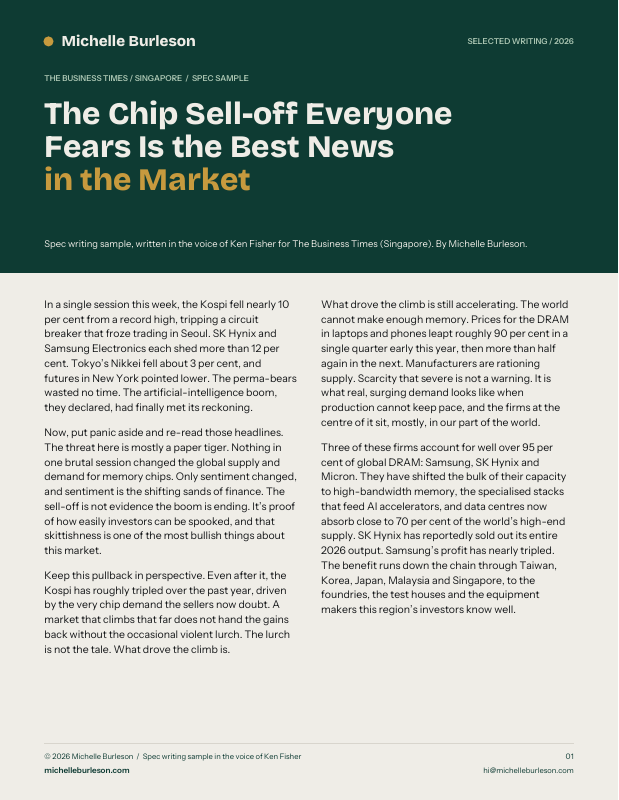
Spec writing sample in the voice of Ken Fisher for The Business Times (Singapore).
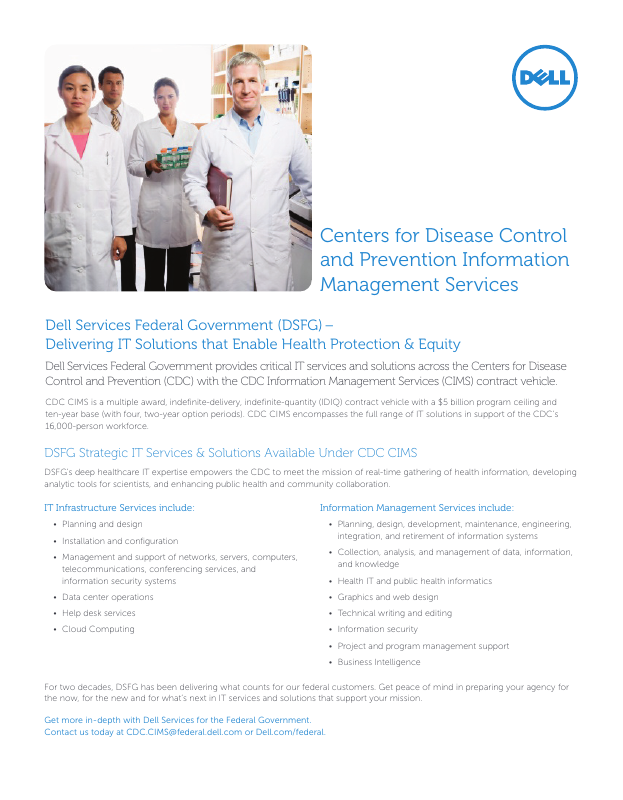
Two pages that explain a $5 billion contract vehicle to procurement officers.
In September 2008 I was writing crisis communications inside Fannie Mae when the federal government took control of the company.
I learned credit default swaps and subprime mechanics the way you learn anything that sticks: under pressure, with smart colleagues, needing to explain it to someone by Friday. The mechanics of a swap don't matter to a family reading a foreclosure notice. What matters is whether someone can draw the line from one to the other in language that doesn't require a finance degree.
That was the job then and it's the job now. I have done it for a federal mortgage giant, a bank, two enterprise technology companies, a hospital system, and a long list of people whose names are on the work instead of mine.
The Inova work won a Standard of Excellence Web Award, which was nice. The better measure is that clients call back.
B.A. in English with honors, George Mason University. I grew up in Korea and read the language.
What it is, who reads it, and when you need it. That's enough to start.